Coastal Roofing & Salt‑Resistance in Australia: 2025 Essential Guide
- July 11, 2025
Living near Australia’s beautiful coastline comes with unique challenges for your home’s roof. The combination of salt-laden air, high humidity, and strong winds creates the perfect storm for accelerated coastal roof corrosion. In fact, roofs within 10km of the shoreline can deteriorate up to three times faster than those further inland. This comprehensive guide explores the science behind coastal roofing salt resistance Australia homeowners need to understand, comparing materials that withstand our harsh marine conditions while providing practical maintenance strategies to extend your roof’s lifespan.
Understanding Salt Corrosion in Coastal Environments
Salt-laden air is the primary culprit behind accelerated roof deterioration in coastal areas. When salt particles combine with moisture and oxygen, they create an electrolyte solution that dramatically speeds up the corrosion process on metal surfaces. This electrochemical reaction breaks down protective coatings and attacks the underlying material.
Salt corrosion damage comparison: Standard roofing (left) vs. marine-grade roofing (right) after 5 years of coastal exposureAustralian Standard AS 2312 Corrosion Categories
Australia’s marine environments are classified according to Australian Standard AS 2312, which defines corrosion categories based on distance from breaking surf or saltwater. Understanding these categories is essential for selecting appropriate roofing materials:
| Category | Environment | Distance from Coast | Corrosion Rate |
| C5 (Very High) | Severe Marine | 0-200m from breaking surf | Extreme (>80μm/year) |
| C4 (High) | Marine | 200m-1km from coast | High (30-80μm/year) |
| C3 (Medium) | Mild Marine | 1-10km from coast | Moderate (15-30μm/year) |
According to CSIRO research, salt deposition rates can vary significantly along Australia’s coastline, with northern tropical regions experiencing different corrosion patterns than southern temperate zones. These regional variations must be considered when selecting roofing materials.
Best Roofing Materials for Coastal Salt Resistance
Selecting the right roofing material is crucial for homes in salt-exposed environments. Each option offers different levels of corrosion resistance, longevity, and value for coastal applications.
Colorbond Ultra steel roofing installed on a modern Australian beachfront homeComparing Marine-Grade Roofing Options
The table below compares the performance of various roofing materials across Australia’s marine corrosion categories, helping you make an informed decision based on your property’s specific location and conditions.
| Roofing Material | C3 Performance | C4 Performance | C5 Performance | Expected Lifespan | Relative Cost |
| Colorbond Ultra | Excellent | Excellent | Very Good | 30-50 years | High |
| Zincalume | Very Good | Good | Poor | 20-40 years | Medium |
| Aluminium | Excellent | Excellent | Excellent | 40-60 years | Very High |
| Copper | Excellent | Excellent | Excellent | 50-100+ years | Premium |
| Terracotta Tiles | Excellent | Very Good | Good | 50+ years | High |
| Fibre Cement | Very Good | Good | Fair | 25-30 years | Medium |
Colorbond Ultra for Severe Marine Environments
Developed specifically for Australia’s harshest coastal conditions, Colorbond Ultra features advanced corrosion protection with a proprietary AM150 coating containing more aluminium and magnesium than standard steel roofing. This marine-grade roofing material is warranted for use in severe marine environments (C5) within 100-200m of breaking surf, making it an excellent choice for beachfront properties.
Cross-section of Colorbond Ultra showing its multi-layer marine-grade protection systemAluminium: Natural Corrosion Resistance
Aluminium roofing offers inherent resistance to salt corrosion through its natural oxide film that self-repairs when damaged. While more expensive than steel options, aluminium’s exceptional durability in severe marine environments makes it cost-effective over its extended lifespan, particularly for homes within 200m of breaking surf.
Terracotta and Concrete Tiles
Non-metallic options like terracotta tiles provide excellent salt resistance without corrosion concerns. Their natural composition makes them ideal for coastal environments, though they require proper installation to withstand high winds. Modern concrete tiles with protective coatings also perform well in marine environments while offering greater design flexibility.
Fasteners and Fixings: The Critical Weak Points
Even the most corrosion-resistant roofing material can fail prematurely if installed with incompatible or inferior fasteners. In coastal environments, fastener selection is just as important as the roofing material itself.
After 3 years in a coastal environment: Standard galvanised screws (left) vs. 316-grade stainless steel fasteners (right)Stainless Steel: The Gold Standard
For severe marine environments (C4-C5), 316-grade stainless steel fasteners are essential. These high-performance fasteners resist chloride attack and maintain structural integrity even with direct salt spray exposure. While more expensive initially, they prevent costly premature failures and roof leaks.
Preventing Galvanic Corrosion
When different metals come into contact in the presence of an electrolyte (like salt water), galvanic corrosion accelerates deterioration. To prevent this:
- Use compatible metals throughout the roofing system
- Install isolation barriers between dissimilar metals
- Apply protective sealants at metal junctions
- Ensure proper drainage to prevent water pooling
- Specify marine-grade flashings and cappings
According to metal roofing experts, proper fastener selection can double the effective lifespan of a coastal roof system.
Protective Strategies for Coastal Roofing
Beyond material selection, several protective strategies can enhance your roof’s resistance to salt corrosion and extend its service life in coastal environments.
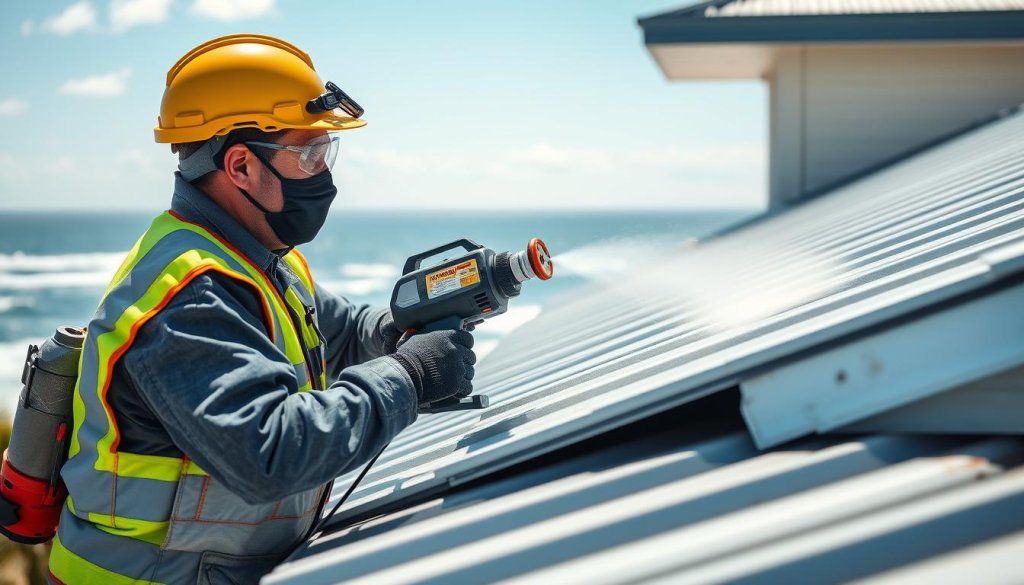
Professional application of marine-grade anti-corrosion coating to extend roof lifespanFactory and Site-Applied Coatings
Factory-applied finishes like PVDF (polyvinylidene fluoride) provide superior UV and chemical resistance. For existing roofs, site-applied protective coatings can add an extra barrier against salt attack. These specialised marine coatings form a sacrificial layer that protects the underlying metal.
Design Considerations for Salt Resistance
Thoughtful roof design can significantly reduce salt accumulation and corrosion risk:
Recommended Design Features
- Steeper roof pitches (>15°) to promote self-cleaning
- Simplified roof lines with fewer valleys and junctions
- Elevated ridge ventilation to reduce moisture buildup
- Extended eaves to protect walls from salt spray
- Sealed roof penetrations with marine-grade flashings
Design Elements to Avoid
- Box gutters that trap salt and moisture
- Complex roof junctions that collect debris
- Dissimilar metals in direct contact
- Inadequate ventilation in roof spaces
- Roof designs that trap salt-laden air
Coastal Roof Maintenance: Your Protection Roadmap
Even the most corrosion-resistant roofing systems require regular maintenance to perform optimally in coastal environments. A proactive maintenance schedule is your best defense against premature deterioration.
Quarterly professional roof cleaning removes accumulated salt deposits before they cause damageMaintenance Schedule for Coastal Roofs
Follow this maintenance roadmap to maximize your coastal roof’s lifespan and maintain warranty coverage:
| Maintenance Task | Frequency (C5 Zone) | Frequency (C4 Zone) | Frequency (C3 Zone) | Professional or DIY |
| Fresh water roof wash-down | Monthly | Quarterly | Bi-annually | Both |
| Gutter cleaning | Monthly | Quarterly | Quarterly | Both |
| Fastener inspection | Quarterly | Bi-annually | Annually | Professional |
| Sealant inspection | Quarterly | Bi-annually | Annually | Professional |
| Full professional inspection | Bi-annually | Annually | Every 2 years | Professional |
Regular roof maintenance is essential for preserving warranties and preventing costly repairs. Document all maintenance activities with photos and receipts to support potential warranty claims.
Proper Cleaning Techniques
When cleaning coastal roofs, follow these guidelines to prevent damage:
- Use low-pressure fresh water (never high-pressure washers)
- Clean from top to bottom to prevent streaking
- Avoid harsh chemicals that may damage protective coatings
- Pay special attention to areas sheltered from rain
- Include thorough gutter cleaning to prevent debris buildup
Case Study: Gold Coast Re-Roof Success
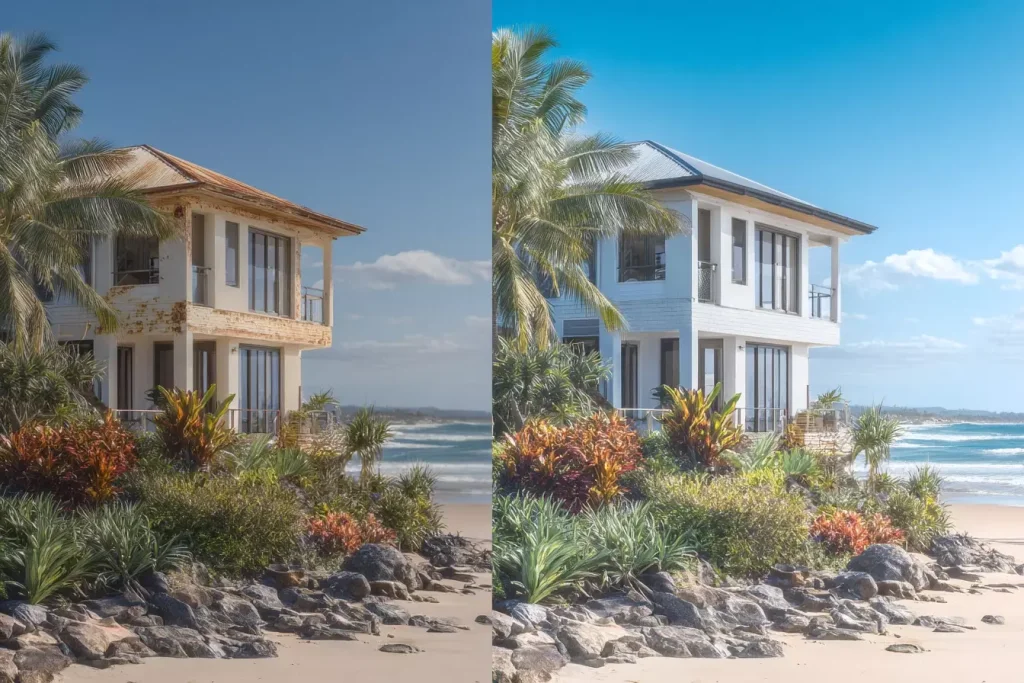
A beachfront property in Surfers Paradise experienced severe corrosion just four years after installing standard Zincalume roofing. The home, located 150m from breaking surf in a C5 marine zone, showed accelerated deterioration despite regular maintenance.
Gold Coast beachfront home: Corroded standard roofing (left) vs. marine-grade replacement after 5 years (right)The Solution
The homeowners invested in a complete re-roof using Colorbond Ultra with 316-grade stainless steel fasteners and implemented a quarterly maintenance program. Five years later, the roof shows no signs of corrosion despite its harsh marine environment.
Performance Data
| Metric | Original Roof (4 Years) | Marine-Grade Roof (5 Years) |
| Visible corrosion | Severe (65% of surface) | None detected |
| Fastener failure rate | 42% requiring replacement | 0% |
| Water ingress incidents | 3 major leaks | None |
| Maintenance costs (annual) | $1,200-1,800 | $600-800 |
| Estimated remaining lifespan | 1-2 years | 25+ years |
While the marine-grade roofing system cost 40% more initially, the homeowners estimate they’ll save over $25,000 in the long term through reduced maintenance and avoiding another premature replacement.
Protecting Your Coastal Roof Investment
Investing in appropriate marine-grade roofing materials and implementing a regular maintenance schedule is the most cost-effective approach for coastal properties. The initial premium for salt-resistant materials pays dividends through extended lifespan, reduced maintenance costs, and protection of your home’s structural integrity.
Regular professional inspections can identify potential issues before they become costly problemsRemember that coastal roofing salt resistance in Australia depends on three key factors: appropriate material selection based on your marine zone classification, quality installation with compatible components, and consistent maintenance. By addressing all three elements, you’ll maximize your roof’s performance and protect your coastal home for decades.
How often should I wash down my coastal roof?
Washing frequency depends on your proximity to the coast. For severe marine environments (C5, within 200m of breaking surf), monthly wash-downs are recommended. For properties 200m-1km from the coast (C4), quarterly cleaning is typically sufficient. Properties 1-10km inland (C3) should schedule bi-annual cleanings. Always use low-pressure fresh water and avoid harsh chemicals that could damage protective coatings.
Is Colorbond Ultra worth the extra cost for coastal homes?
For properties within 200m-1km of breaking surf (C4-C5 zones), Colorbond Ultra’s enhanced corrosion resistance typically justifies its 15-25% price premium over standard Colorbond. The extended lifespan (30-50 years vs. 15-25 years for standard materials in these environments) and reduced maintenance requirements generally provide positive return on investment. For homes beyond 1km from the coast, standard Colorbond may be sufficient with proper maintenance.
Can I retrofit corrosion protection to my existing coastal roof?
Yes, existing roofs can benefit from retrofitted protection measures. Professional application of marine-grade anti-corrosion coatings can extend roof life by 5-10 years. Replacing standard fasteners with 316-grade stainless steel versions can prevent premature failure at connection points. However, these measures are most effective when corrosion is still in early stages. Severely corroded roofing generally requires replacement with appropriate marine-grade materials.
How do cyclone requirements affect coastal roofing choices?
In cyclone-prone coastal regions of northern Australia, roofing must meet both corrosion resistance and wind uplift requirements. Metal roofing systems with cyclone-rated clips and closer batten spacing provide excellent performance in these dual-threat environments. Colorbond Ultra and properly installed aluminium systems offer both salt resistance and cyclone certification when installed to Australian Standard AS 1562.1 specifications.
What documentation should I keep for coastal roof warranty claims?
Maintain a comprehensive maintenance log including dates, services performed, contractor details, and before/after photos. Keep all product warranty certificates, installation invoices, and material specifications. Most marine-grade roofing warranties require proof of regular maintenance performed to manufacturer specifications. Without this documentation, warranty claims for premature corrosion may be denied, even with premium materials.
Book Your Free Coastal Roof Assessment
Protect your coastal home from salt corrosion with a comprehensive roof assessment. Our marine roofing specialists will evaluate your current roof condition, identify early corrosion signs, and recommend appropriate materials and maintenance strategies for your specific marine zone.
Book Free Assessment
How Green Roofs Reduce Urban Heat: A Sustainable Solution for Australian Cities
Read More »BAL Compliance for Roofs: A Comprehensive Guide to AS 3959 Standards
Read More »Roofing Compliance for Class 5-9 Buildings in Australia: A Guide to NCC Standards
Read More »At Roofs.com.au, we are dedicated to providing top-quality roofing services across Australia. With years of experience in the roofing industry, we have earned a reputation for delivering reliable, efficient, and high-quality roofing solutions.
Navigation
Get in Touch
We’d love to hear from you! Whether you need a roof inspection, a free quote, or emergency roof repairs, our team is ready to assist you. Please visit our Contact Page to get in touch with us.
Contact Us Copyright © Roofs.com.au. All Rights Reserved.Roofs.com.au
REQUEST A QUOTE
At Roofs.com.au, we take pride in being responsive, reliable, and ready to solve all your roofing needs. Simply complete the form & one of our team member will be in contact with you shortly.
Request a QuoteRoofs.com.au
Submit your interest
Submit your interest using the form below. We will review your details and get back to you.
Images on This Page
-
https://roofs.com.au/wp-content/uploads/2025/05/roofs.com_.au-logo.png
(no alt text)
-
https://roofs.com.au/wp-content/uploads/2025/07/Colorbond-Ultra-steel-roofing-installed-on-a-modern-Australian-beachfront-home-with-coastal.jpeg
Colorbond Ultra steel roofing installed on a modern Australian beachfront home with coastal roofing salt resistance
-
https://roofs.com.au/wp-content/uploads/2025/07/image-14-1024x683.webp
(no alt text)
-
https://roofs.com.au/wp-content/uploads/2025/07/image-15-1024x683.webp
(no alt text)
-
https://roofs.com.au/wp-content/uploads/2025/07/Professional-applying-anti-corrosion-coating-to-metal-roofing-in-a-coastal-Australian-setting-1024x585.jpeg
Professional applying anti-corrosion coating to metal roofing in a coastal Australian setting
-
https://roofs.com.au/wp-content/uploads/2025/07/image-16-1024x683.webp
(no alt text)
-
https://roofs.com.au/wp-content/uploads/2025/07/image-17-1024x683.webp
(no alt text)
-
https://roofs.com.au/wp-content/uploads/2025/07/Before-and-after-images-of-a-coastal-roof-cleaning-showing-salt-deposit-removal.jpeg
Before and after images of a coastal roof cleaning showing salt deposit removal
-
https://roofs.com.au/wp-content/uploads/2025/07/image-18-1024x683.webp
(no alt text)
-
https://roofs.com.au/wp-content/uploads/2025/07/Professional-roofer-inspecting-a-coastal-homes-roofing-system-for-salt-damage-1024x585.jpeg
Professional roofer inspecting a coastal home's roofing system for salt damage
-
https://roofs.com.au/wp-content/uploads/2025/07/image-97.webp
(no alt text)
-
https://roofs.com.au/wp-content/uploads/2025/09/image.webp
(no alt text)
-
https://roofs.com.au/wp-content/uploads/2025/07/image-130.webp
(no alt text)
-
https://roofs.com.au/wp-content/uploads/2024/07/roofs.com_.au-logo-2.png
(no alt text)